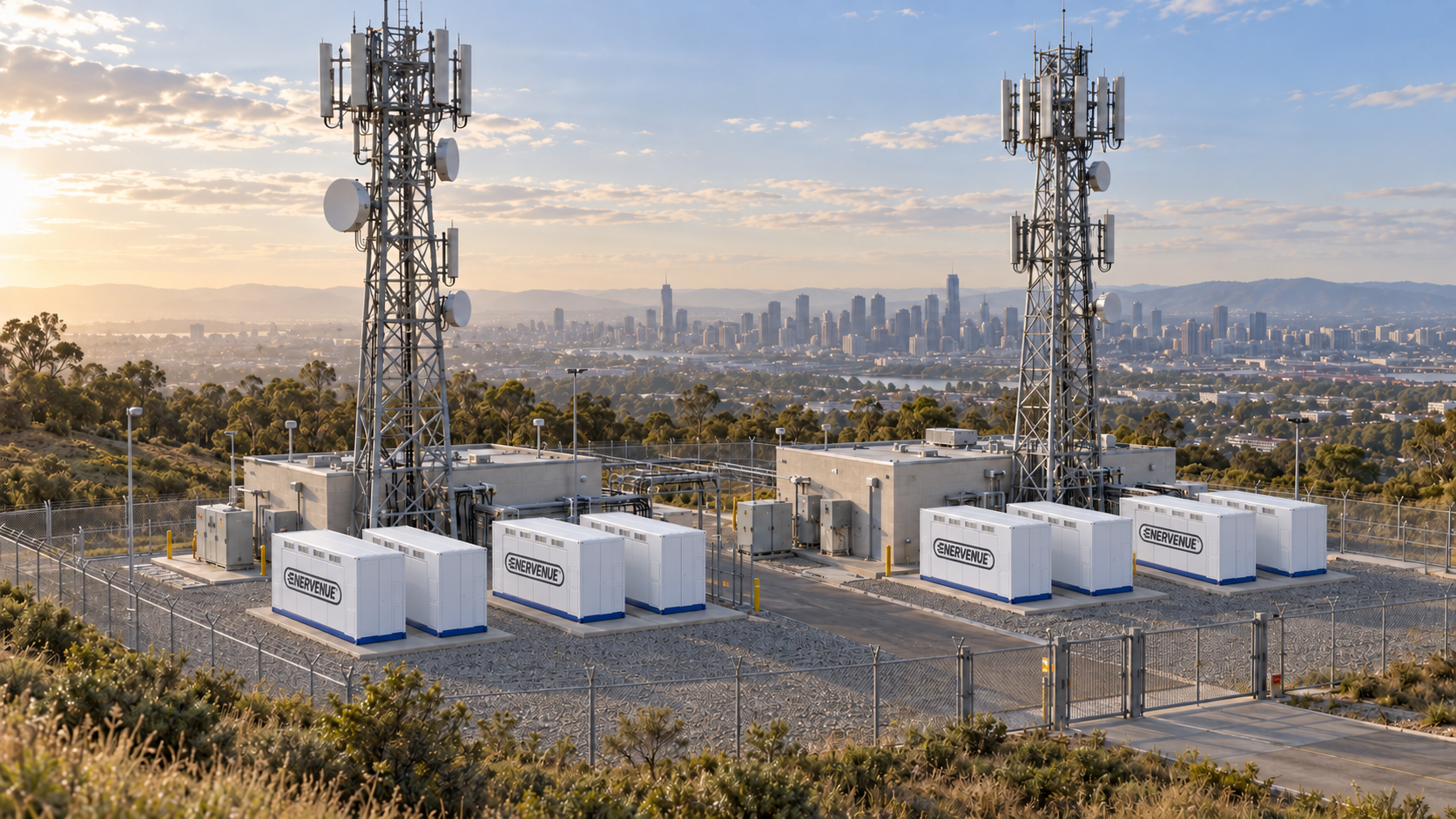
Telecom networks run on distributed lead-acid: strings of VRLA batteries at tower sites and exchanges, replaced every five to ten years as a fact of life, and in three to five years at sites that cycle daily on an unstable grid. Each replacement is a truck, a technician, lifting gear, a disposal chain and a site visit that costs more than the batteries on it, multiplied across thousands of sites for the life of the network. Lithium replacements have arrived with a competitive first cost and a fire-code conversation the tower owner never had to have before. The battery line in a network's operating budget is really a transport line.
The Energy Core is designed for this duty: 30 kWh at 48 Vdc, built for the telecom DC plant, natural-air cooled, IP21, on a cell designed for 30,000 cycles and 30 years with no equalisation, no watering and no technician cadence. The chemistry is aqueous and non-flammable with zero risk of fire from thermal runaway, at unstaffed sites where a battery fire is discovered by the outage it causes. The daily cycling that kills lead-acid in three years is inside the design envelope. The Energy Core is a product on our roadmap for distributed and remote sites, and this page describes the job it is built for.
The replacement events come off the thirty-year plan, and the truck rolls, the disposal chain and the swap-outage risk go with them. One procurement against three or four. Site by site, the comparison stops being battery price against battery price.
Illustrative scenario built on published industry data and EnerVenue's product specifications. It does not describe a specific EnerVenue customer or installation.
Join industry leaders who turn to our briefing for insights and analysis on storage technology, market shifts, and real-world deployments.
— Early access to industry research & whitepapers
— Market insights on energy storage trends
— Technology deep-dives from our engineering team