
Technology
The chemistry that ran satellites is now available on Earth.

Not a new technology seeking validation. A proven chemistry, developed for the most demanding environments ever built, refined for grid-scale deployment, and available today.
The Chemistry
Built without the failure modes. Manufacturable anywhere in the world.
The Aqueous Metal Cell contains a nickel hydroxide cathode and a nickel alloy anode in an alkaline electrolyte. On charge, hydrogen gas is produced and stored inside a sealed, large format cell. On discharge, hydrogen reaction is reversed. The system is hermetically sealed. No liquid spillage. No venting under normal conditions. No thermal cascade pathway.
The stability is not engineered in. It is inherent to the chemistry.
There is no flammable organic solvent. There is no lithium intercalation or incompatible chemical reaction. There is no lithium plating. These are the common failure modes responsible for thermal runaway events in conventional battery systems. The AMC does not have them.
The system requires no active thermal management in normal operating conditions. Suitable for hot and cold climates. Lab tested -20°C to 60°C. The most durable and resilient battery ever built for grid-scale deployment.
The raw materials are steel, nickel, fiberglass, resin, and water. No rare earths. The cell can be manufactured in any major industrial region. At end of life, the nickel can be recovered and reused.
For governments and utilities building long-term energy infrastructure, this is a supply chain resilience argument, not a sustainability footnote.
The Building Block
One proven cell. No compromises at scale.
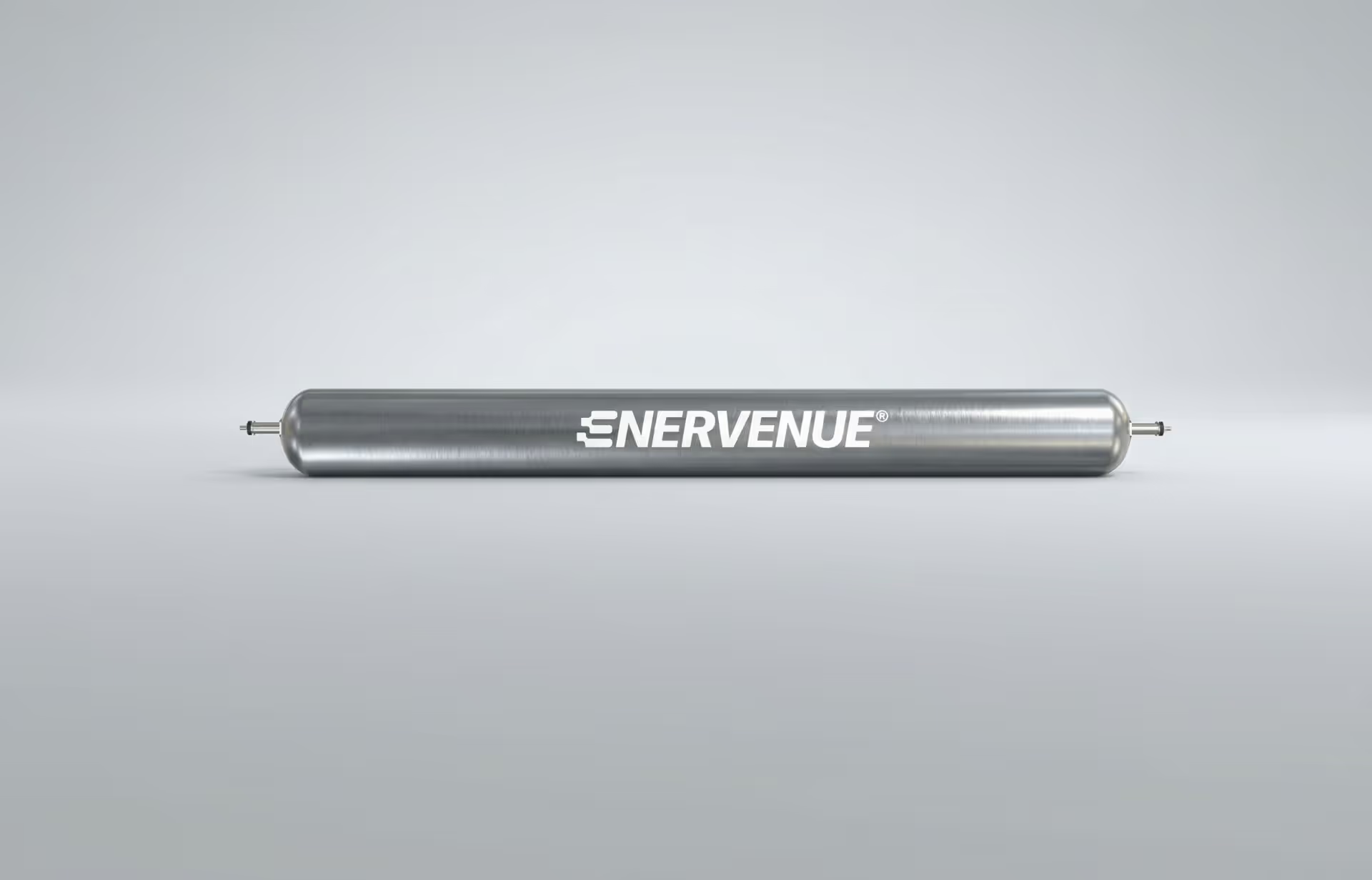
The Aqueous Metal Cell is the foundation. 3 kWh of usable energy in a sealed, large format cell. Every Energy Rack is built from AMCs. Every project is built from Energy Racks.
The same cell, the same chemistry, the same 30-year design life — from a single unit to a DC block ready to connect to an AC system.
Scale does not change the performance guarantee.
90%+
Round-trip efficiency
No
Augmentation required
Flexible
Charge / discharge profile
Ultra Low
Lifetime operating cost
The Proof
30,000 cycles. 100% depth of charge and discharge. Verified.
The data that makes the operational and financial case.
Metric
AMC
Li-Ion
Flow
Iron Air
Cycle design life
30K+
6,000–8,000
15,000–20,000
10,000
Efficiency
90%+
90%+
50–60%
30–50%
Maintenance
Low
High
High
Moderate
Charge / Discharge
Flexible
Limited
Long duration only
Ultra long duration only
Rest cycles
No
Required
Required
N/A
Lab Temperature Range
-20°C to +60°C
5°C to 30°C
-20°C to 50°C
-5°C to 45°C
HVAC dependency
Flexible
Strict
Flexible
Flexible
Fire risk (thermal runaway)
None
High
Low
Low
Supply chain
Flexible
Restrictive
Flexible
Flexible
Use cases
Many
Many
Limited
Limited
Augmentation
No
Yes
Chemical additions
No
CapEx
Moderate
Low
High
High
OpEx
Ultra low
High
Moderate
Low
LCOS
Low
Moderate
High
High
The Proof
30,000 cycles. 0.2% degradation per year. Verified.
The data that makes the operational and financial case.
AMC (EnerVenue)
Cycle design life
30k+
Efficiency
90%+
Maintenance
Low
Charge / Discharge
Flexible
Rest cycles
No
Lab Temperature Range
-20°C to +60°C
HVAC dependency
Flexible
Fire risk (thermal runaway)
None
Supply chain
Flexible
Use cases
Many
Augmentation
No
CapEx
Moderate
OpEx
Ultra low
LCOS
Low
Li-Ion
Cycle design life
6,000–8,000
Efficiency
90%+
Maintenance
High
Charge / Discharge
Limited
Rest cycles
Required
Lab Temperature Range
5°C to 30°C
HVAC dependency
Strict
Fire risk (thermal runaway)
High
Supply chain
Restrictive
Use cases
Many
Augmentation
Yes
CapEx
Low
OpEx
High
LCOS
Moderate
Flow
Cycle design life
15,000–20,000
Efficiency
50–60%
Maintenance
High
Charge / Discharge
Long duration only
Rest cycles
Required
Lab Temperature Range
-20°C to 50°C
HVAC dependency
Flexible
Fire risk (thermal runaway)
Low
Supply chain
Flexible
Use cases
Limited
Augmentation
Chemical additions
CapEx
High
OpEx
Moderate
LCOS
High
Iron Air
Cycle design life
10,000
Efficiency
30–50%
Maintenance
Moderate
Charge / Discharge
Ultra long duration only
Rest cycles
N/A
Lab Temperature Range
-5°C to 45°C
HVAC dependency
Flexible
Fire risk (thermal runaway)
Low
Supply chain
Flexible
Use cases
Limited
Augmentation
No
CapEx
High
OpEx
Low
LCOS
High
Certified
Independently tested. Zero thermal runaway incidents.
UL 9540A
Thermal runaway fire propagation test procedures and observations completed at the cell level. No flaming. Safety validated.
Common chemistries like lithium-ion demonstrate flaming at the cell level and require extensive module and system protection to reduce risk.
Sites deploying EnerVenue do not require fire auxiliary suppression infrastructure due to inherently safer chemistry. This reduces cost, speeds permitting, and simplifies maintenance. Fewer sub-systems increases reliability. No risk of fire from thermal runaway also creates siting advantages — systems can be placed near population centers and critical infrastructure.
UL 1973
Certified compliant with ANSI/CAN/UL 1973. Certifying to UL 1973 is another crucial safety benchmark for large scale energy storage systems, signaling electrical safety, thermal management, mechanical durability, and environmental safety. It validates safety at the module and rack level.
Additional IEC and UL safety standards, and product certifications, are available or in progress.
Zero risk of fire from thermal runaway
Independently Verified
"30,000 cycles. The highest cycle life of any technology studied."
— Ara Ake, Future Energy Development (NZ)
Ara Ake studied ten battery chemistries. EnerVenue's outperformed everyone.
Ara Ake, New Zealand's Future Energy Development agency, conducted an independent analysis of more than ten battery chemistries for stationary storage applications. Nickel-hydrogen outperformed every other chemistry studied across technical, commercial, safety, and environmental dimensions for applications under 12 hours.
Three findings from the report:
30,000 cycles. The highest cycle life of any technology studied.
13× lower environmental impact per kWh across the full asset lifetime.
On a lifetime basis, nickel-hydrogen has among the highest energy output of all technologies studied.
Source: Ara Ake — Future Energy Development, New Zealand Government
Born to Empower. Built to Endure.
Speak with an Advisor