
Article ·
July 29, 2026
Australia's Next Energy Challenge Isn't Generation. It's Reliability
Guy Henshilwood
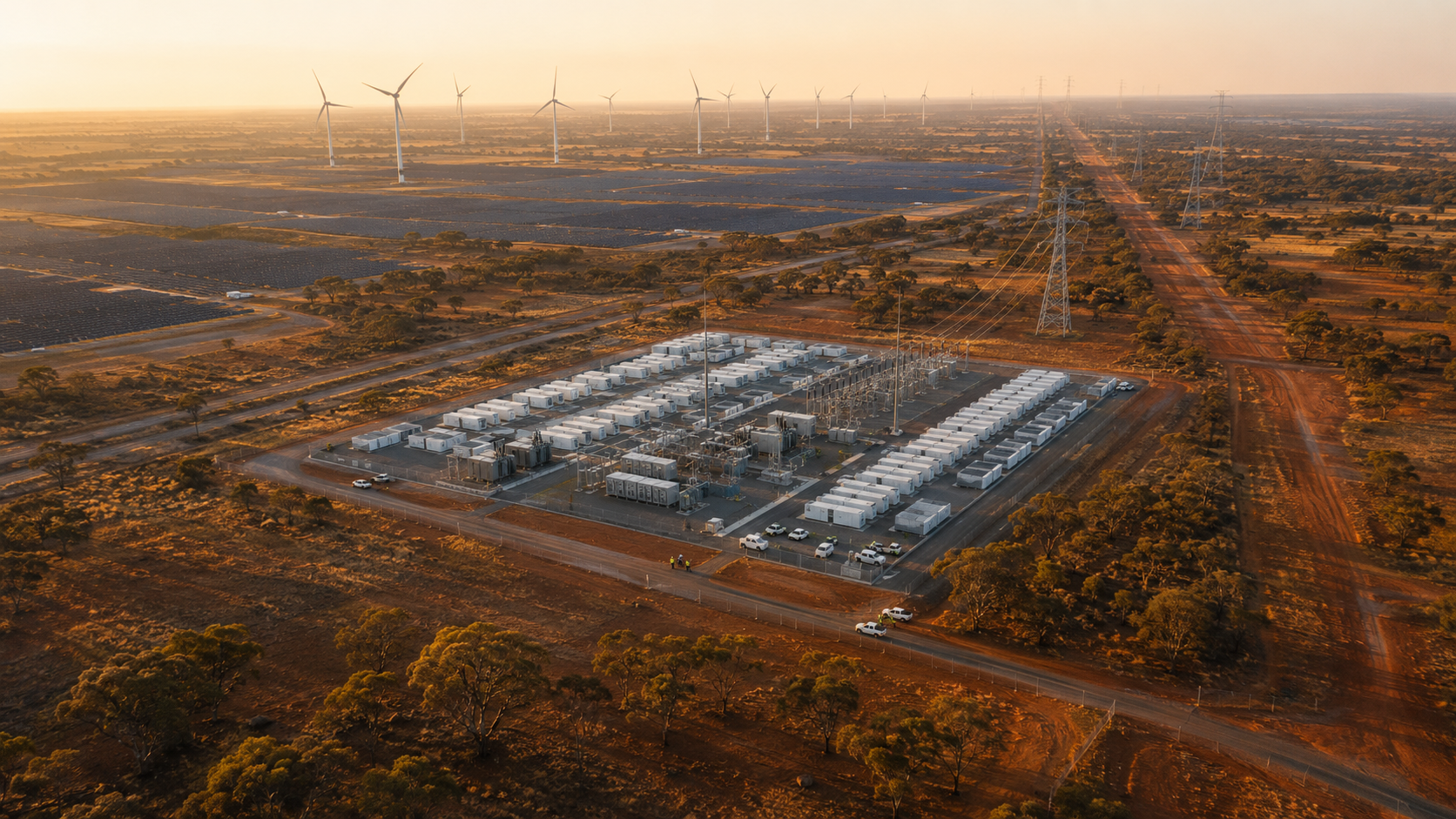
Renewables supplied 42.7 per cent of Australia's electricity in 2025, up from 38.9 per cent the year before. New renewable capacity additions reached 5.9 GW, a 28.3 per cent rise year onyear. Large-scale battery capacity grew by 233 per cent, making Australia the third-largest utility-scale battery market in the world.
Coal still supplied just under half the mix.
Both figures describe the same story. Australia is building at record pace but still has a long way still to go, and the reliability of what it builds now depends on storage.
Can renewable energy be delivered with the certainty that modern economies depend
on?
Electricity has value only when it is available.
Solar produces most of its energy in the middle of the day. Wind output varies with weather conditions. Demand follows neither pattern. Around four million Australian homes now have rooftop solar, the highest penetration of any country, concentrating a large share of daily supply into the middle of the day. Storage, transmission and system flexibility are becoming the infrastructure that turns renewable energy generation into dependable energy provision.
AEMO chief executive Daniel Westerman has described what replaces Australia's retiring coal fleet as least-cost renewable energy, backed with storage, connected in with transmission, supplemented by some gas for winter. Storage sits in that description as infrastructure, alongside generation and transmission. AEMO's Integrated System Plan builds on the same premise, with renewables projected to reach 75 per cent of National Electricity Market supply by 2030 against an 82 per cent national target, constrained by planning approvals, supply chains,social licence and construction.
Energy storage is becoming a new class of critical infrastructure. It still balances fluctuations in renewable output and provides ancillary services, and those roles now sit inside a larger one,which changes how it should be evaluated.
The scale of Australia's storage build-out sharpens the point. Home battery sales rose 260 percent between 2024 and 2025, with almost 270,000 units purchased. Australia has passed 2 GWh of battery storage per million people, a rate one analyst at Rystad Energy described as an unprecedented build-out. Capacity is being committed now, at volume, on procurement standards written when storage was still treated as balancing equipment. Warranty horizons of ten to fifteen years are being applied to assets the system expects to rely on for decades. The build-out is running ahead of the standards being applied to it, and the consequences of that gap arrive in the 2030s.
Infrastructure is rarely judged by its lowest construction cost. Roads, ports, airports, transmission networks and water systems are valued because they continue delivering reliable service over decades. Investors judge them by certainty, durability and lifetime value across decades of service.
Asset owners, utilities and investors are placing greater emphasis on the economics of the entire operating life of the system. Longevity, operational simplicity, safety, predictable maintenance requirements and lifecycle economics matter because they determine whether anasset continues creating value long after it has been deployed.
The conversation, in other words, is moving from “What does this battery cost? “ and “Whatdoes this infrastructure asset deliver over thirty years?”
Longevity becomes increasingly valuable because storage is expected to operate alongside renewable assets designed to perform for decades. Frequent cycling becomes critical because renewable firming requires storage to charge and discharge every day, not simply during occasional grid events. Operational simplicity improves availability while reducing maintenance demands, particularly for remote infrastructure. Safety influences permitting, insurance, financing and public acceptance, extending well beyond engineering considerations.
In March, the New South Wales Investment Delivery Authority endorsed sixteen projects worth $22.1 billion through a streamlined assessment process, covering pumped hydro, battery storage, wind and solar. At that scale and speed, safety characteristics feed directly into approval timelines and financing terms.
This is why lifecycle economics is becoming a more meaningful measure of value than upfront capital cost alone. Technologies that minimise augmentation, reduce operational complexity and continue performing predictably over decades create stronger long-term economics even when their initial capital cost is not the lowest.
No single storage technology will serve every application.
Australia's future electricity system will require a portfolio of solutions. Short-duration systems will continue providing fast-response services and network support. Pumped hydro will remain valuable where geography and economics allow.
Long-duration storage answers a narrower requirement: dependable energy day after day, year after year, across applications where reliability carries real economic value, including utility- scale renewable integration, mining, commercial and industrial facilities, remote infrastructure, and the electricity demands of artificial intelligence and data centres.
Its role is to provide dependable energy day after day, year after year, across applications where reliability carries significant economic value, utility-scale renewable integration, mining operations, commercial and industrial facilities, remote infrastructure, and the rapidly growing electricity demands created by artificial intelligence and data centres.
These applications increasingly reward technologies designed specifically for permanent, stationary energy infrastructure rather than adapted from applications built around entirely different priorities.
EnerVenue's Aqueous Metal Cell architecture was engineered for that role, built around endurance, daily cycling, operational simplicity and predictable performance across a thirty-year life, matching the operating lives of the renewable assets it supports.The broader point, however, extends well beyond any single technology.
Australia's energy transition is entering its second chapter.
The first was about replacing conventional generation with cleaner sources of electricity.
The second is about ensuring that clean energy can be delivered with the reliability expected of
critical infrastructure.
Every generation builds the infrastructure that defines its economy.
The twentieth century built roads, ports, pipelines and transmission networks.
The twenty-first century will also build the infrastructure that makes clean electricity dependable.
That may prove to be the defining challenge and the defining investment opportunity of
Australia's energy transition
REFERENCES AND SOURCE NOTES
Clean Energy Council (CEC), Clean Energy Australia 2026
Supports the discussion of Australia’s renewable electricity share, clean energy
momentum and battery energy storage deployment growth.
Australian Energy Market Operator (AEMO), 2026 Integrated System Plan
Supports the discussion of least-cost system planning, coal retirement, reliable and
secure electricity supply, government policy settings, and the long-term development
pathway for the National Electricity Market.
Infrastructure Australia, Renewable Generation
Supports the discussion of constrained delivery, the 75% renewable electricity projection
for 2030 under constrained conditions, the 82% national renewable electricity target, and
delivery barriers including planning approvals, supply chains, social licence and
construction challenges.
National Renewable Energy Laboratory (NREL), energy storage cost and LCOS frameworks
The energy landscape is changing fast. Stay ahead.
Join industry leaders who turn to our briefing for insights and analysis on storage technology, market shifts, and real-world deployments.
— Early access to industry research & whitepapers
— Market insights on energy storage trends
— Technology deep-dives from our engineering team
Related Articles
Born to Empower. Built to Endure.
Speak with an Advisor