
Article ·
March 12, 2026
Levelized Cost of Storage (LCOS) Explained: Evaluating 30-Year Battery Economics
Henning Rath, CEO, EnerVenue
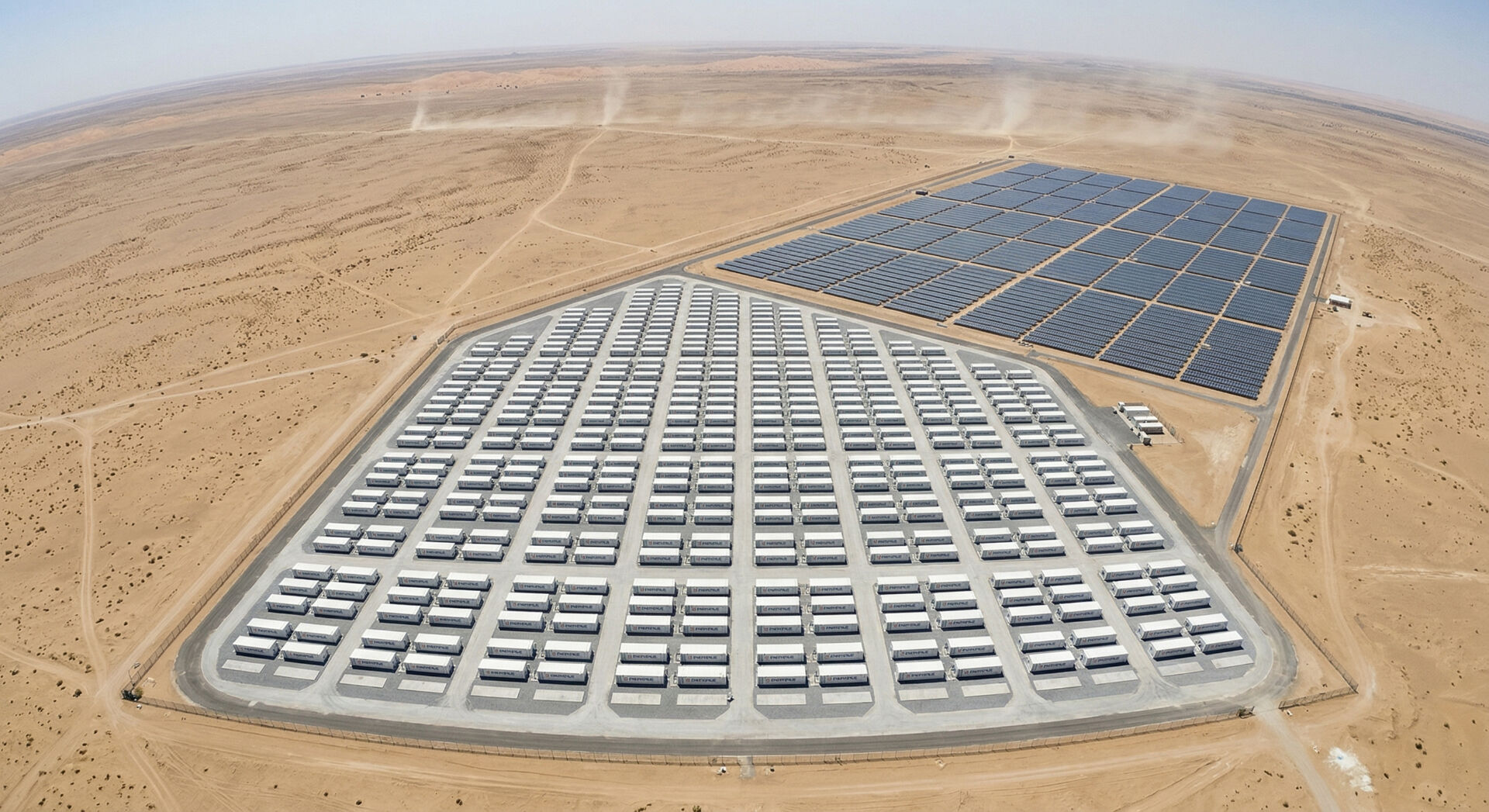
Energy storage is increasingly expected to function as infrastructure, yet procurement decisions are still often anchored to upfront capital cost (CAPEX). That gap between expectation and evaluation defines whether storage compounds value over decades or embeds structural cost into long-lived assets.
As electrification accelerates, artificial intelligence expands load demand and power variability, and climate volatility increases dispatch frequency—trends highlighted in International Energy Agency electricity outlooks—storage systems are no longer short-term balancing tools. They are infrastructure layers expected to deliver reliable energy across 20 to 30 years. Under those conditions, the relevant economic question is not what a battery costs on day one, but what it costs to deliver sustained energy over its full life.
Levelized Cost of Storage (LCOS) is the framework that makes that distinction visible.
LCOS measures total lifecycle cost divided by total delivered energy, a definition formalized in National Renewable Energy Laboratory (NREL) cost modeling frameworks. It integrates capital expenditure, operating costs, auxiliary consumption, efficiency losses, degradation, augmentation, and financing assumptions into a single economic lens. Properly modeled, it forces procurement discipline aligned with long-horizon infrastructure thinking.
In infrastructure finance, cost is much more than CapEx.
LCOS Is About Energy, Not Installed Capacity
Power is instantaneous and measured in megawatts. Energy is power delivered over time and measured in megawatt-hours. LCOS evaluates cost per unit of delivered energy across the system's operational life, not cost per unit of installed capacity.
Two storage systems may appear similar at commissioning. Yet if one degrades rapidly under frequent cycling while another sustains stable performance, their lifetime delivered energy diverges materially. Because LCOS divides cost by delivered energy, degradation directly reshapes economics—a dynamic reflected in Lazard's Levelized Cost of Storage analyses.
Procurement models focused primarily on CAPEX per kilowatt-hour implicitly assume that installed capacity remains economically usable across the planning horizon. In reality, degradation curves determine whether that assumption holds. If delivered energy declines faster than modeled, LCOS rises as cost is spread over fewer megawatt-hours.
The economic lens must therefore shift from nameplate capacity to lifetime throughput.
Throughput Is the Economic Engine
Throughput—the cumulative energy a system can deliver over its life—is the engine of LCOS.
Modern storage assets cycle frequently to balance renewables, manage peak demand, and support reliability in volatile markets, as described in IEA flexibility and grid integration studies. In high-utilization environments, cumulative cycle capability and chemical endurance determine whether throughput compounds or deteriorates.
A system optimized for early-year economics but not engineered for sustained cycling may appear competitive under conservative dispatch assumptions. However, as utilization increases, degradation accelerates and augmentation may be required sooner to maintain optimal energy capacity. Each augmentation event introduces incremental capital and operational complexity, increasing lifecycle cost.
Degradation slope also interacts with financing assumptions. Systems that lose capacity rapidly concentrate economic value in early years, making LCOS highly sensitive to discount rate assumptions. Systems with stable, predictable degradation distribute value across decades, reducing sensitivity to capital market volatility.
Endurance stabilizes financial modeling.
Degradation and Augmentation Shape 30-Year Outcomes
In long-horizon analysis, degradation is not a technical footnote. It is a structural cost driver.
If capacity declines materially, either delivered energy decreases or augmentation capital must be deployed to restore performance. Both outcomes affect LCOS. Either the denominator shrinks or total cost increases. Over 30 years, even moderate differences in degradation profile compound into significant economic divergence.
Predictability becomes as important as durability. Infrastructure investors require credible degradation trajectories because revenue forecasts, insurance assumptions, and capital allocation decisions depend on stable performance expectations.
Complicating matters, in large energy infrastructure projects, operational expenditures (OPEX) are frequently underbudgeted or projected inaccurately, in part because early budgeting tends to focus heavily on capital costs and oversimplified assumptions about future operating conditions. This stems from optimism bias and flawed estimates, which often fail to capture the full range of maintenance, reliability, and operational risks once the facility enters service. Such underestimation of ongoing costs is a recognized issue in infrastructure projects overall, where cost forecasts tend to be too low and projects routinely exceed their original budgets, leading to financial strain and risk exposures that were not fully accounted for in initial planning, a phenomenon extensively documented in infrastructure research by Bent Flyvbjerg.
EnerVenue's architecture was engineered around endurance and repeated cycling, with cumulative cycle capability measured in the tens of thousands and structural longevity aligned with multi-decade infrastructure horizons. This durability supports high lifetime throughput and stable degradation behavior under frequent dispatch, strengthening the credibility of long-term LCOS modeling.
When delivered energy remains predictable, cost per delivered megawatt-hour remains disciplined.
Thirty-Year Economics Redefine "Cheap"
LCOS as Infrastructure Discipline
A 10-year evaluation window may tolerate steeper degradation because the asset is treated as transitional. A 30-year horizon exposes whether those assumptions embed volatility.
Under long-term LCOS modeling, augmentation frequency becomes a strategic variable. Each intervention introduces capital deployment risk and exposure to future supply chain pricing. Systems with unstable degradation profiles may require recurring structural adjustment to maintain performance, increasing lifecycle uncertainty.
This is the cost of standing still. Selecting storage based primarily on upfront capital cost may preserve near-term optics, but it can commit operators to higher long-run LCOS through accelerated degradation and recurring augmentation. What appears inexpensive at procurement can become structurally expensive across decades of real-world cycling.
EnerVenue's positioning reflects a shift from commodity battery procurement toward enduring energy infrastructure. When evaluated across 30 years, endurance and predictable degradation become primary economic differentiators rather than secondary features. Augmentation is removed from the equation.
Built for the Cost of Standing Still
Energy storage is transitioning from a consumable piece of equipment to a long-lived infrastructure layer. As climate volatility intensifies and AI-driven demand increases the value of reliable energy delivery, lifecycle economics will determine competitive advantage—a shift reflected in long-term system modeling by NREL and the IEA.
Developers and asset owners slow to understand or adopt this change risk failing due to outdated and short-term thinking.
In infrastructure finance, cost is not defined by what is paid upfront. It is defined by what endures.
The systems that will define the next generation of storage will not be those that minimize initial expenditure, but those that maximize sustained energy delivery with disciplined, predictable economics.
That is the economic standard EnerVenue was built to meet.
The energy landscape is changing fast. Stay ahead.
Join industry leaders who turn to our briefing for insights and analysis on storage technology, market shifts, and real-world deployments.
— Early access to industry research & whitepapers
— Market insights on energy storage trends
— Technology deep-dives from our engineering team
Related Articles
.jpeg)
Born to Empower. Built to Endure.
Speak with an Advisor