
Article ·
September 1, 2026
The Gulf Is Turning Energy Storage Into Infrastructure
Guy Henshilwood
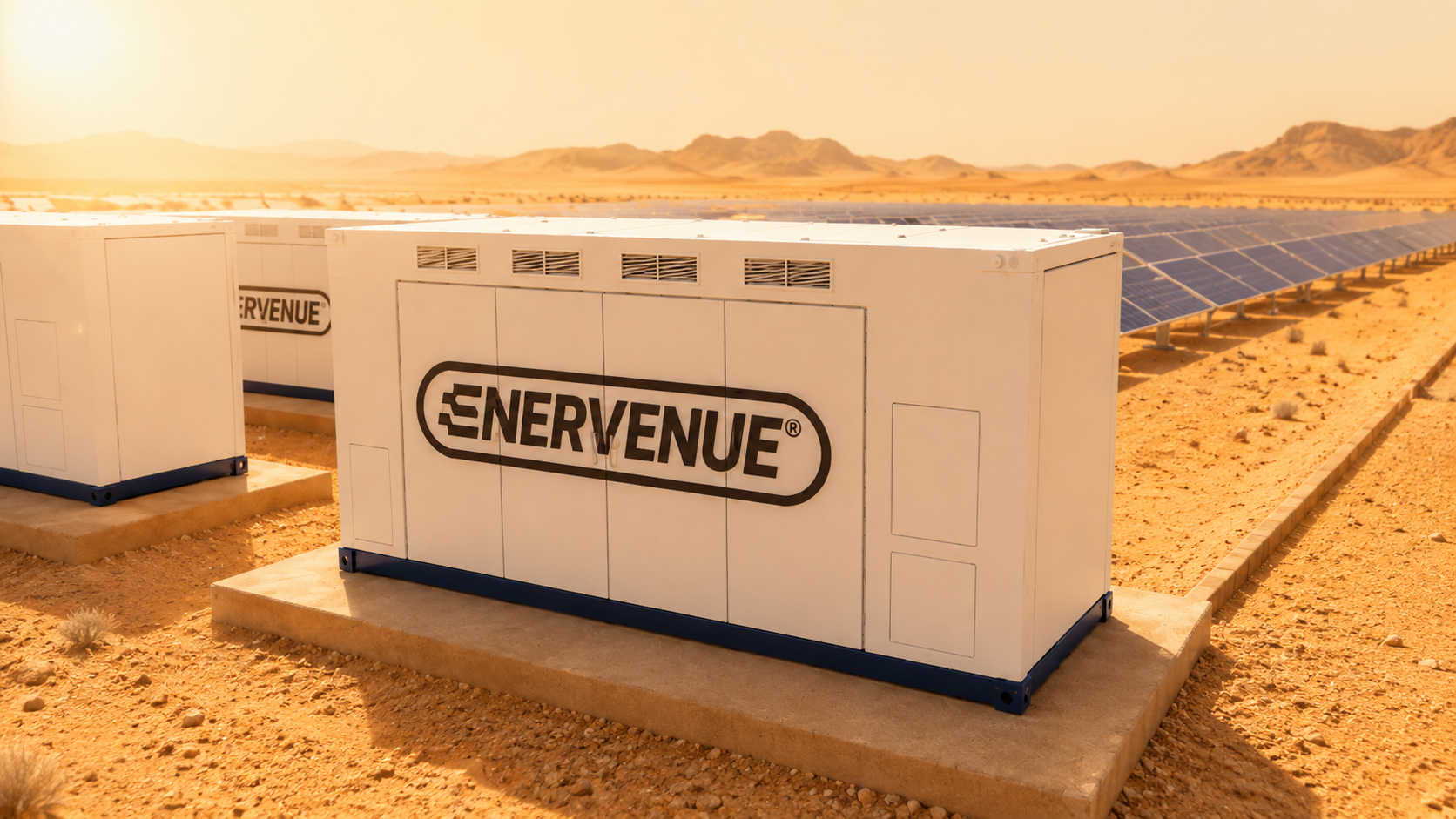
The Gulf has already demonstrated that it can deploy energy storage at extraordinary scale. As projects become larger, ownership periods extend and operating conditions become more demanding, the region is beginning to expose a more important question about storage economics: what will these assets cost to operate and sustain over their full working lives?
The Middle East is rapidly becoming one of the world's most consequential proving grounds for energy storage. Saudi Arabia is targeting up to 130 GW of renewable capacity by 2030 alongside plans for 48 GWh of energy storage, while Dubai's seventh phase of the Mohammed bin Rashid Al Maktoum Solar Park is being procured with 1,400 MW of battery storage at six-hour duration, equivalent to 8,400 MWh of stored energy.
These projects are beginning to embed storage into the operating architecture of Gulf electricity systems. They are also being developed in a region where temperatures can exceed 50°C, assets may be expected to cycle intensively for many years, and procurement structures are placing greater responsibility for lifetime performance on asset owners.
Much of the global storage market has developed around the economics of acquisition: installed capacity, upfront capital cost and cost per kilowatt-hour. Those measures remain important, but an asset expected to operate for 15, 20 or 30 years will accumulate costs and performance changes long after commissioning.
For Gulf infrastructure owners, those years increasingly belong in the procurement calculation.
The economics after commissioning
High temperatures make this particularly visible. The UAE recorded temperatures of 51.2°C this summer, conditions that bring thermal management, auxiliary energy consumption and long-term operating performance directly into the economics of storage.
Every storage architecture has operating requirements, and those requirements accumulate over time. Cooling consumes energy. Maintenance requires labour, parts and capital. Degradation can reduce available capacity. Augmentation can require additional equipment to be purchased, transported and installed years after the original asset entered service.
Cooling, maintenance and augmentation may look manageable as individual line items. Across an infrastructure timeframe, their cumulative effect can materially alter project economics.
A system that appears economically attractive at commissioning may look different after years of cooling, maintenance and augmentation are incorporated into the financial model. Conversely, a technology carrying a higher initial capital cost can become more competitive if it reduces those requirements over a sufficiently long operating period.
The calculation becomes particularly important as the market moves toward longer-duration storage and intensive daily use.
Dubai's Phase Seven procurement illustrates the point. An 8,400 MWh system capable of six hours of discharge is significant as installed capacity, but its economic value will ultimately depend on the energy it delivers repeatedly over the life of the project. If it performs a daily shifting role, the investment case is shaped not simply by the number of megawatt-hours installed on day one, but by cumulative useful throughput over many years.
Duration and longevity describe different characteristics of a storage asset. Duration measures how long a system can deliver energy during a discharge. Longevity measures how long the asset can continue performing its required duty across years and cumulative cycles. For owners, that difference affects capacity retention, maintenance requirements, augmentation planning and ultimately project returns.
Ownership changes the technology decision
Saudi Arabia adds another dimension through the way storage is being procured.
The Saudi Power Procurement Company is developing large-scale storage through build-own-operate structures. Its first group comprises four projects totalling 2 GW and 8 GWh, with project companies responsible for developing, financing, constructing, owning and operating the assets under 15-year Storage Services Agreements. A second group comprises six projects totalling a further 3 GW and 12 GWh.
Under this structure, technology risk remains with the owner well beyond commissioning.
Degradation, augmentation capital, maintenance expenditure, insurance exposure and long-term safety compliance remain part of the owner's economic reality throughout the operating period. The technology decision made during procurement therefore continues to influence the balance sheet for years after construction is complete.
Lowest initial cost remains relevant, particularly at the scale being contemplated across the Kingdom. It sits alongside the cost of maintaining contracted performance. An owner ultimately needs an asset capable of delivering the required energy service at an acceptable cost throughout the period in which it remains economically responsible for that asset.
As build-own-operate structures become more common, lifecycle performance moves from a technical specification into the economics of ownership.
The same calculation applies across the Gulf as storage is deployed alongside renewable generation, for grid balancing, remote infrastructure and firm energy strategies. Higher utilisation and longer expected operating lives increase the importance of lifetime throughput to project economics.
Where endurance enters the investment case
Long ownership periods and frequent cycling place particular demands on storage technologies designed for infrastructure-scale applications.
EnerVenue's Aqueous Metal Cell (AMC™) uses a metal-hydrogen architecture designed for applications where endurance, inherent stability and operational simplicity carry significant value. The Fourth-generation Aqueous Metal Cell has design figures of 30,000 cycles and a 30-year design life, including operation at up to three cycles per day. Those figures describe the design basis of the technology and should be considered separately from warranty terms or demonstrated field life.
The architecture also has zero risk of fire from thermal runaway. No dedicated battery fire suppression is required because there is no propagating battery fire to suppress, although wider site, electrical and installation fire-protection requirements continue to apply.
The same cell architecture can be configured across durations from approximately 45 minutes to 12 hours. For owners, this creates the ability to address different duty cycles through system configuration without changing the fundamental chemistry.
Against Gulf operating requirements, the relevance is practical. Frequent cycling increases cumulative throughput. High ambient temperatures make thermal behaviour and auxiliary consumption material operating considerations. Long ownership periods increase exposure to degradation and augmentation risk, while remote installations place greater value on systems requiring less intervention.
There are also trade-offs. EnerVenue's upfront cost per kilowatt-hour is higher than the lowest-cost lithium-ion alternatives, its energy density is lower, and the company has yet to deliver a gigawatt-scale project. Those factors should remain part of any serious procurement assessment.
Initial capital cost remains part of every procurement decision. For a long-lived infrastructure asset, it sits alongside degradation, augmentation, maintenance, auxiliary consumption, safety requirements and useful lifetime throughput. Together, these determine what the asset ultimately costs over its working life.
That is a considerably broader test than the price of the battery on the day it arrives.
From regional capacity to regional capability
Saudi Arabia's storage expansion also raises an industrial question.
Vision 2030 is concerned not only with adding generating and storage capacity, but with developing greater industrial capability within the Kingdom. As energy storage becomes a larger component of the electricity system, the ability to localise elements of its manufacturing and supply chain becomes strategically relevant.
The Aqueous Metal Cell uses nickel, steel, glass-fibre composite and a water-based electrolyte. Its materials proposition is straightforward: No lithium, no rare earths, more readily recyclable.
EnerVenue's high-volume manufacturing hub in Changzhou is currently providing the industrial proving ground for the technology, with production scaling ahead of completion of a 250 MWh production line and a planned expansion to 1 GWh. The longer-term manufacturing model is intended to be replicable as demand, operating experience and commercial scale support expansion into additional regions.
For Saudi Arabia, localisation can extend beyond assembling imported systems. It can encompass engineering knowledge, manufacturing expertise and regional supply chains around technologies that become part of the Kingdom's long-term energy infrastructure.
A different benchmark for storage
The Gulf's importance to the global storage industry may ultimately have less to do with how many gigawatt-hours it deploys than with what those deployments reveal over time.
Most storage markets have accumulated operating knowledge gradually. The Gulf is attempting something different. Renewable generation, storage capacity and wider electricity infrastructure are being expanded simultaneously and at substantial scale, under some of the world's most demanding climatic conditions.
Many storage projects being contracted today will be expected to operate well into the 2040s, while the consequences of current infrastructure decisions may extend into the 2050s. Their eventual economics will be determined by far more than their commissioning price. Capacity retention, cumulative energy delivery, auxiliary consumption, maintenance requirements and augmentation capital will all contribute to the final cost of the energy service they provide.
Gulf procurement decisions could therefore influence how the wider storage industry measures value. Greater emphasis on lifetime performance alongside acquisition cost would favour a definition of storage economics based on the cost and certainty of delivering energy over time, rather than installed capacity alone.
Dubai's six-hour projects will provide evidence about the economics of sustained throughput. Saudi Arabia's build-own-operate model will test how lifetime technology performance translates onto an owner's balance sheet. Remote and off-grid applications across the region will demonstrate the value of operational simplicity where maintenance and intervention carry an additional cost.
These projects will subject the next generation of energy storage to a demanding real-world test.
The Gulf has already shown that it can deploy storage quickly and at scale. Assets installed during this period will now have to deliver the required energy service economically across the decades for which they are being built.
Their performance over those decades will determine whether storage can be valued with the same long-term discipline applied to other forms of infrastructure.
Storage that must be replaced is a cost. Storage that endures is infrastructure.
Born to Empower. Built to Endure.
The energy landscape is changing fast. Stay ahead.
Join industry leaders who turn to our briefing for insights and analysis on storage technology, market shifts, and real-world deployments.
— Early access to industry research & whitepapers
— Market insights on energy storage trends
— Technology deep-dives from our engineering team
Related Articles
Born to Empower. Built to Endure.
Speak with an Advisor