
Article ·
October 27, 2026
Australia is building battery capacity. Is it valuing lifetime performance?
Boris Cicero
All 15 batteries in Australia's latest Capacity Investment Scheme tender are lithium-ion, and none of them runs for much more than four hours. AEMO expects the grid to need a lot more storage in the four-to-12-hour range over the next two decades, doing different jobs in different places. Future tenders will need to be designed around those jobs.
Fifteen contracts, all lithium-ion, all around four hours
In June 2026, the federal government's Capacity Investment Scheme (CIS) selected 15 projects representing 4.2 GW of output capacity and 16.1 GWh of stored energy. All 15 projects use lithium-ion technology, although the tender was open to any technology that met its terms, including pumped hydro and compressed air. The tender attracted 73 bids proposing 76.4 GWh of storage, almost five times the energy target, with the government estimating that successful projects will unlock approximately A$6 billion in private investment.
Lithium-ion's position is understandable. Manufacturing scale, competitive pricing, established supply chains and familiarity among financiers and engineering contractors provide substantial advantages when projects must meet demanding commercial and construction schedules. The awarded projects also have something else in common: almost all of them are four-hour batteries.
Based on published output and energy capacity figures, three of the 15 projects provide less than four hours of nominal storage, most cluster around four hours, and none exceeds approximately 4.1 hours. Across the portfolio, the aggregate duration is approximately 3.8 hours. Much of that is by design. Tender 8 asked for four-hour-equivalent capacity, and four-hour lithium-ion batteries are the most competitive way to provide it today.
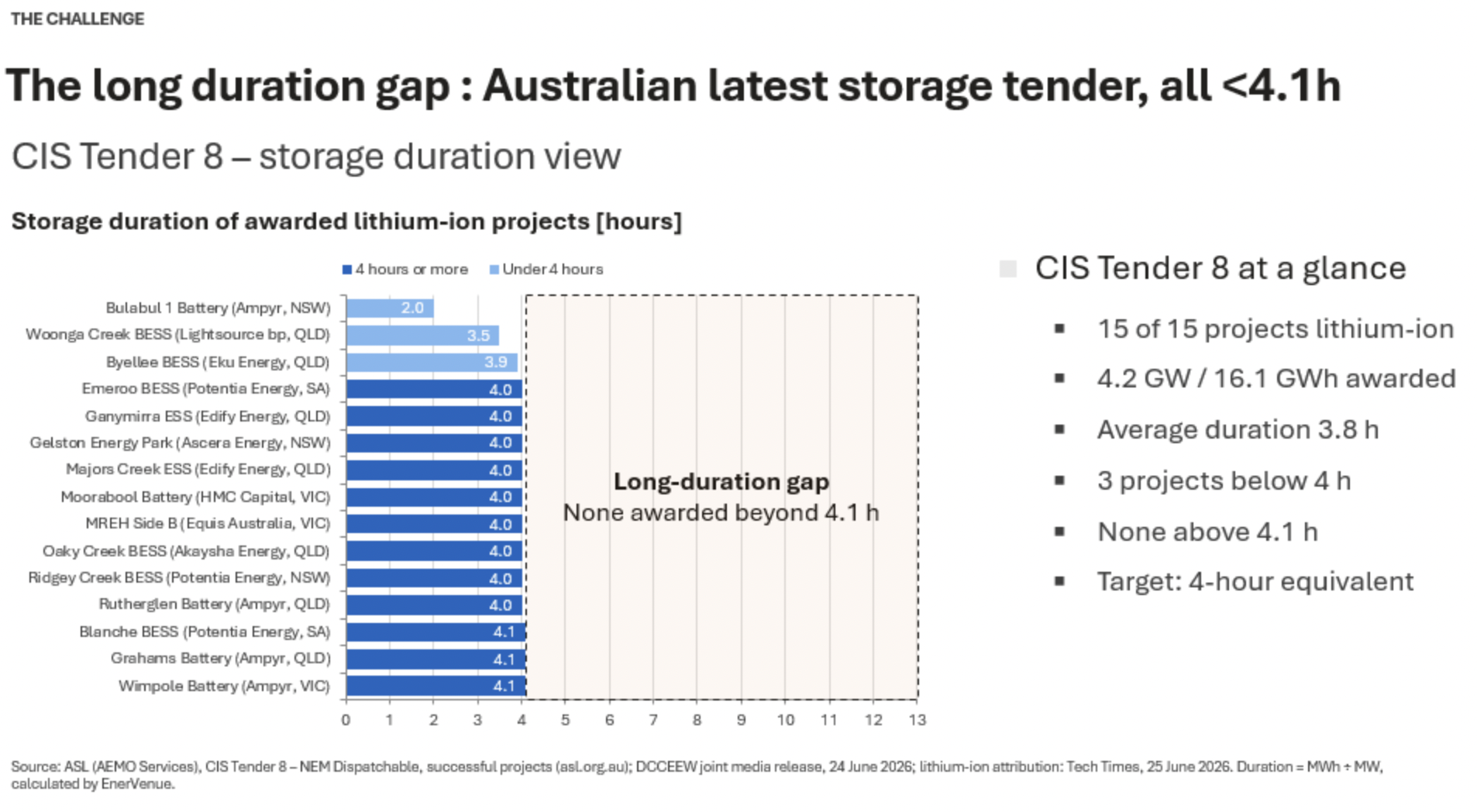
Figure 1. Nominal storage duration of the 15 successful CIS Tender 8 projects, calculated from published MW and MWh specifications. All projects use lithium-ion technology, and none exceeds approximately 4.1 hours. Source: AEMO Services and Australian Government Tender 8 results; duration calculations presented by EnerVenue.
Under the Australian Energy Market Operator's (AEMO) classification, four-hour systems fall within medium-duration storage, defined as four to 12 hours. Australia is therefore already procuring medium-duration storage at scale, but only at the very bottom of that range.
What AEMO expects the grid to need
AEMO's final 2026 Integrated System Plan provides a clearer picture of Australia's changing storage requirements. Under its Step Change scenario, utility-scale storage reaches approximately 36 GW and 473 GWh by 2029–30. That includes 18 GW and 43 GWh of shallow storage, 15 GW and 74 GWh of medium-duration storage, and approximately 2.4 GW and 356 GWh of deep storage.
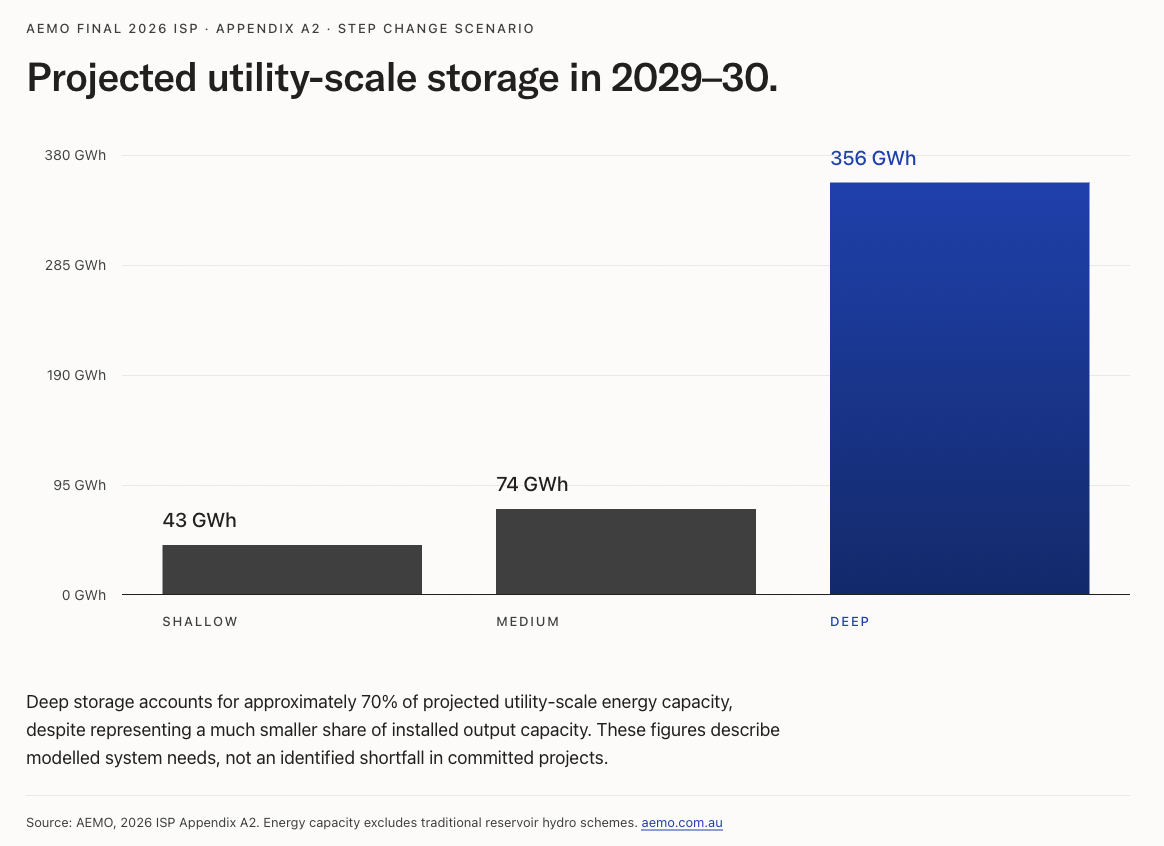
Deep storage accounts for approximately three-quarters of projected capacity in energy terms, but almost all of that is one project: Snowy 2.0, the committed pumped-hydro scheme, which is designed to hold around 350 GWh.
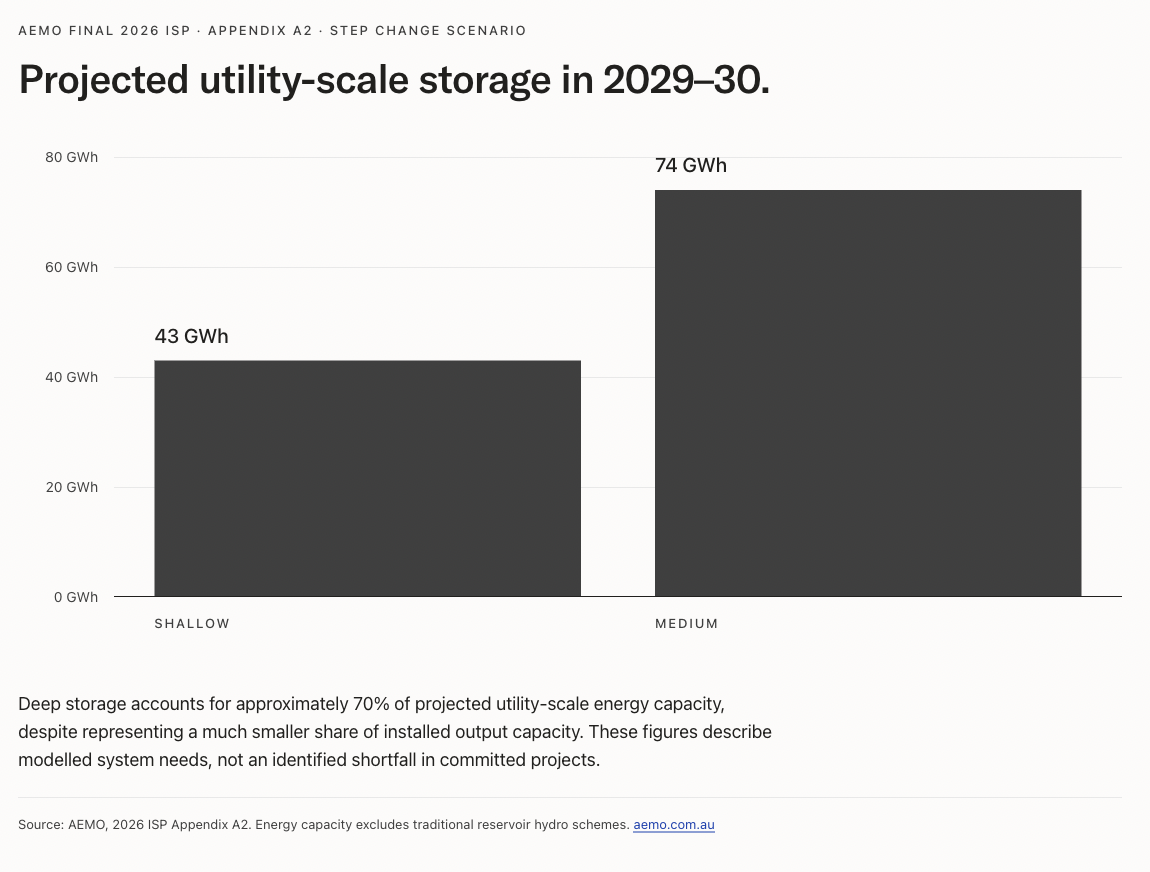
The bigger change is in medium-duration storage. In AEMO's Step Change scenario, medium-duration capacity increases from 15.3 GW in 2029–30 to 27.7 GW by 2049–50, while shallow storage declines from 18 GW to 8.1 GW over the same period.
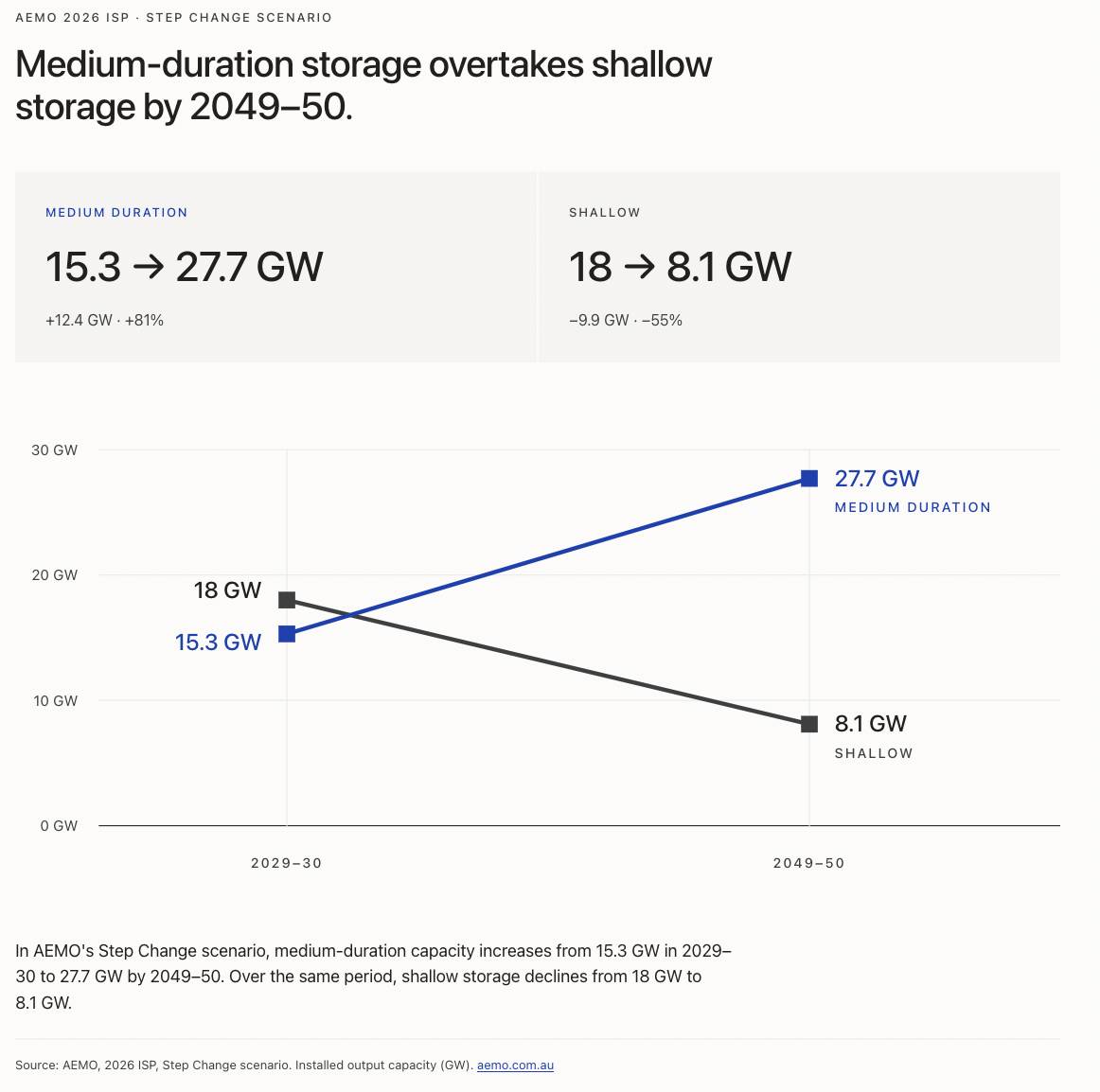
Set that beside Tender 8 and the gap is easy to see. The awards sit at the four-hour floor of the medium-duration band, while the band AEMO expects to keep growing runs all the way to 12 hours.
Different jobs need different storage
On the grid, storage does several quite different jobs, and each job asks something different of the asset.
Short, frequent work, such as frequency control and moving midday solar into the early evening, needs power more than endurance. Batteries of two to four hours do this well, lithium-ion has made them cheap, and most of what Australia has built so far is doing exactly this. It will keep doing it.
Covering the evening peak and the night, as coal plants close, needs storage that can discharge for eight to 12 hours, often every day. That is the medium-duration band AEMO expects to grow, and it is where long-duration batteries, flow batteries and smaller pumped-hydro schemes compete.
Riding through several days of low wind and heavy cloud, or moving energy from one season to the next, needs storage measured in days rather than hours. That is the job of large pumped hydro such as Snowy 2.0.
Duration is only part of the picture. The same eight-hour job looks different on a site that cycles two or three times a day, at a Pilbara mine where summer temperatures regularly pass 40°C, or beside a hospital, a substation or a data centre where a battery fire is an unacceptable risk. The number of cycles, the heat an asset has to work in, how close it can sit to people and equipment, and how long it has to last before it is replaced all change which technology is the right one.
Long-duration storage sits alongside the four-hour fleet. Four-hour batteries will keep doing the daily work they are good at, and longer-duration assets can cover the hours after that. A tender that names the job it wants done lets each technology be judged on how well it does that job.
Paying for longer duration
AEMO models the infrastructure required to maintain a reliable and economically efficient electricity system. Developers and investors, however, make decisions based on expected revenues, financing conditions, construction risks and contractual obligations.
A storage asset can be worth a great deal to the grid during a few still, cloudy winter weeks and still not earn enough from everyday trading to get built. An asset that cycles every day has a much clearer route to revenue through energy trading and system services.
The CIS helps address investment uncertainty through revenue underwriting, while its assessment process also considers project deliverability. The duration, performance requirements and scoring set in each tender decide which technologies can compete for that underwriting.
As coal generation retires and storage assumes a greater role in maintaining grid reliability, the services the system requires must become things a project can be paid to provide. If a service is not clearly defined or properly paid, the technology that could provide it will struggle to raise finance.
Counting the cost over 30 years
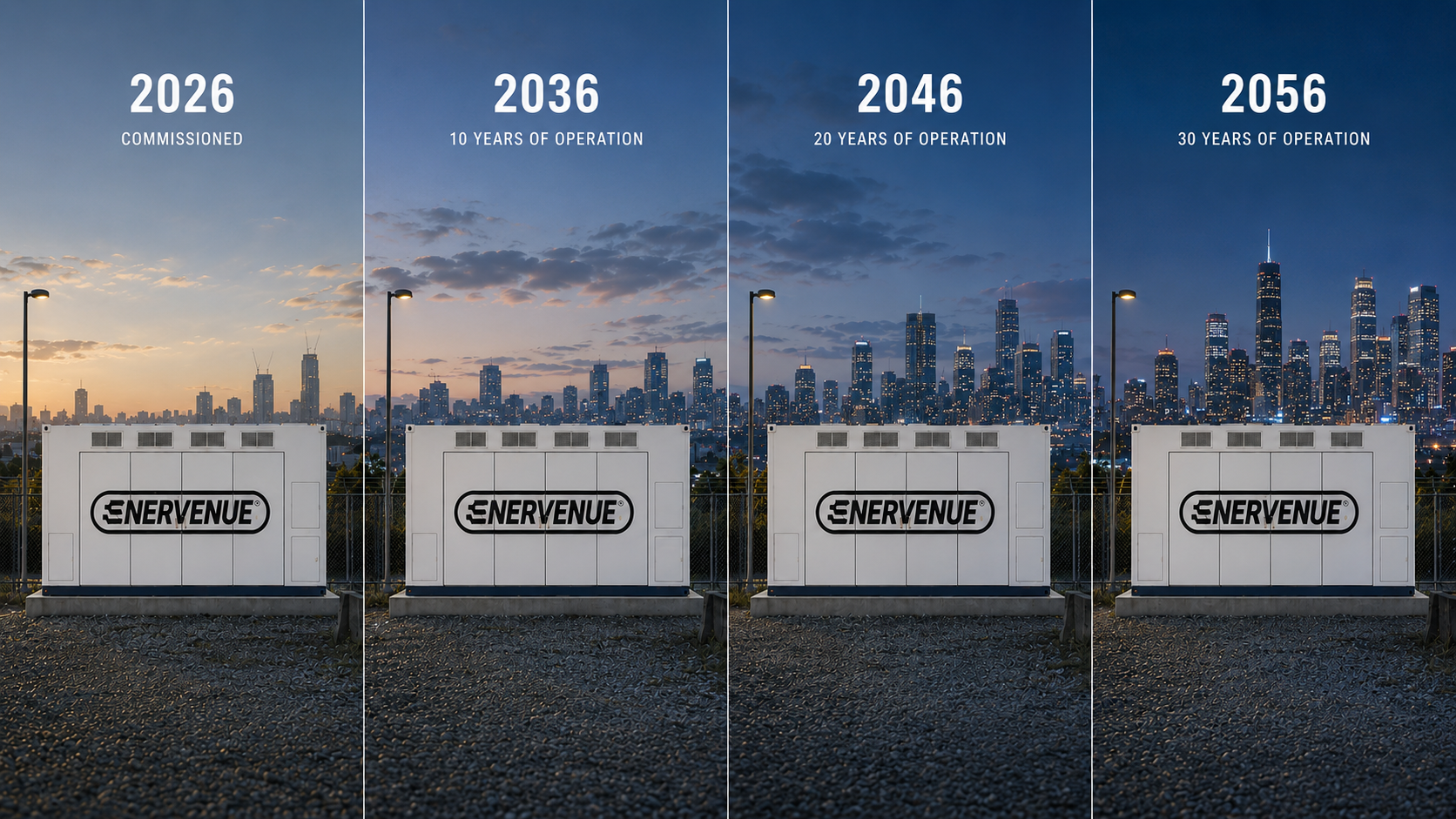
Storage contracted today will run alongside solar and wind farms built to operate for around 30 years, connected by poles and wires that last longer still. Over that time, the asset that is cheapest to build is not always the cheapest to own.
For investors, that means looking at how much energy an asset will actually deliver over its life: how quickly it degrades, how often it has to be augmented or replaced, how much energy it uses to keep itself cool, and how much of the time it is available to run.
Initial capital expenditure remains essential, particularly where financing conditions and construction costs directly influence project viability. But a price per kilowatt-hour at contract says little about degradation, augmentation or replacement. Scoring storage on the cost of the energy it delivers over its life, for the job it is being bought to do, gives a fairer comparison.
Why fire safety belongs in the economic assessment
Safety regulation is another factor shaping storage investment. In a recent EcoGeneration article, EnerVenue CEO Henning Rath examined how Australia's battery fire-safety frameworks have developed around the hazards associated with lithium-ion technology. Those hazards require appropriate engineering controls, but different battery chemistries behave very differently when something goes wrong, and the rules do not yet reflect that.
Australia's regulatory arrangements draw on building requirements, state fire-authority guidance, international standards and site-specific engineering assessments. Recognised testing methods, including UL 9540A, can provide evidence to inform fire-protection requirements and installation design. Performance-based compliance pathways already offer flexibility in appropriate circumstances, and they could be applied more consistently, based on how each technology actually behaves.
These rules affect cost as well as safety. Battery hazard characteristics can influence separation distances, site layout, fire protection, emergency access, water provision, building design and insurance assessments. These requirements may affect project cost, permitting complexity and usable land, particularly near industrial facilities, population centres or critical infrastructure.
A risk-based approach should maintain rigorous safety outcomes while evaluating technologies according to their test results and actual hazards. It must also distinguish battery-specific risks from the fire-protection requirements of the wider electrical installation. More predictable engineering and regulation would benefit developers, regulators and insurers while preserving consistent safety expectations across technologies.
What Australia's next storage framework should reward
CIS Tender 10, targeting another 4 GW and 16 GWh of dispatchable capacity in the National Electricity Market, closed for bids in August 2026. It may be the final dispatchable tender under the scheme, provided the remaining targets are met. After that, the market arrangements that follow the CIS will decide how each kind of storage gets paid.
The starting point is to define the grid service before comparing technologies. Daily energy shifting, peak firming, extended renewable shortfalls and essential system services have different operating requirements. Duration, availability and dispatch performance should be assessed against the conditions in which an asset is expected to operate. Lifecycle economics should form part of that evaluation, accounting for degradation, efficiency, maintenance, augmentation, operating expenditure and delivered energy over the relevant investment horizon.
Safety and deliverability must receive equal attention. Installation requirements should reflect demonstrated hazards and test evidence, with consistent safety outcomes across technologies. Manufacturing readiness, construction schedules, grid integration and financing credibility are equally important because procurement awards alone do not deliver operational infrastructure.
Research published by Modo Energy following Tender 8 shows why this matters. Across CIS rounds, Modo reported that only 1.8 GW of the 17.5 GW of awarded battery capacity had reached final investment decision at the time of its analysis.
Future tenders and market arrangements should therefore look at the whole picture: the service required, how the asset will perform, the risks it carries over its life, and whether it can actually be delivered. Weighting those factors by the service being bought lets each technology compete on how well it meets a clearly defined need.
From storage capacity to infrastructure value
Australia has made substantial progress in developing a commercial market for utility-scale storage. Lithium-ion has been central to that progress and will continue to serve important roles in renewable energy integration and grid reliability.
AEMO's modelling points towards a growing role for medium-duration storage, supported by deep-storage infrastructure and other flexible resources. The next round of tenders and market reforms is the chance to pay for it, by naming the services the grid needs and judging each technology on what it delivers over its life.
Where EnerVenue fits
EnerVenue's Aqueous Metal Cell is built for the medium-duration work AEMO expects to grow. It is designed for 30,000 cycles over a 30-year life at up to three cycles a day, with no augmentation, and the same cell covers discharge durations from 45 minutes to 24 hours.
The cell's water-based electrolyte is non-flammable, and it carries zero risk of fire from thermal runaway. It is UL 9540A and UL 1973 certified.
In Western Australia, EnerVenue is working with Horizon Power, and further projects are under development across the country.
Boris Cicero, EnerVenue's Business Development Manager for Australia, presents "15 for 15 to Lithium: The long-duration gap in Australia's storage build" at All-Energy Australia in Melbourne on 28 October 2026.
Sources
Australian Government: CIS Tender 8 results
Energy-Storage.news: Australia awards 4.2GW/16.1GWh of battery storage under CIS Tender 8
Australian Government: CIS Tender 10 status
Modo Energy: CIS Tender 8 analysis
EcoGeneration: Henning Rath on Australia's battery fire rules
UL Solutions: UL 9540A Test Method for Battery Energy Storage Syste
The energy landscape is changing fast. Stay ahead.
Join industry leaders who turn to our briefing for insights and analysis on storage technology, market shifts, and real-world deployments.
- Early access to industry research & whitepapers
- Market insights on energy storage trends
- Technology deep-dives from our engineering team
Related Articles
Born to Empower. Built to Endure.
Speak with an Advisor