
Article ·
August 11, 2026
Buying for Year Thirty with Day-One Numbers
Guy Henshilwood
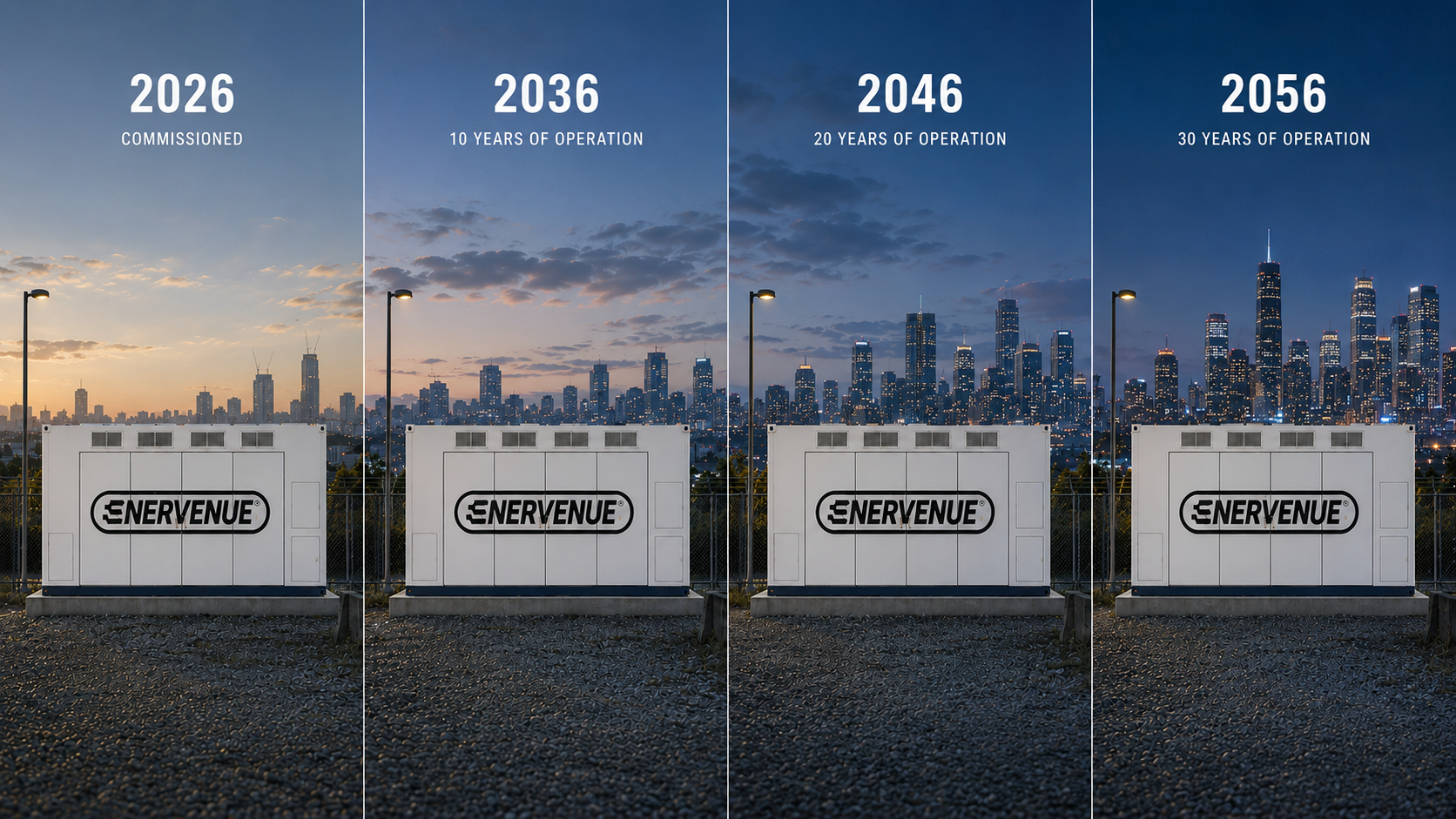
Open any energy storage specification and the numbers look confident. Round-trip efficiency to one decimal place. Cycle life in the tens of thousands. Degradation as a tidy annual percentage. Nameplate capacity in megawatt hours.
Every one of those figures describes the same moment. The day the system is commissioned.
That was adequate when storage was a two-year pilot bolted onto a solar farm. It has become inadequate, because the thing being bought has changed. Storage now sits inside electricity networks, industrial plants, mining operations and data centre campuses, and those are assets with thirty-year horizons, financing structures, insurance policies and maintenance budgets attached to them. Buyers need to have confidence in how their asset will be performing in year thirty. The data sheets still describes day one.
Mature markets buy predictability
Every infrastructure market passes through this. Early on, buyers reward capability, because the open question is whether the technology works at all. Performance figures are the right instrument for that question, and the market rewards whoever posts the best ones.
Once a technology is established, the people making decisions are no longer engineers establishing feasibility. They are asset owners, lenders and insurers managing exposure across decades, and their question is not how good the best case looks but how narrow the range of outcomes is. Predictability begins to outrank peak performance, because an asset that behaves as modelled can be financed and an asset that surprises you cannot.
Energy storage crossed into that phase somewhere in the last three years.
The incumbent earned its maturity
It is worth being straight about how far conventional technology has come, because the maturity argument cuts both ways.
Lithium-ion did not stand still. EPRI’s BESS Failure Incident Database shows the rate of failure incidents per cumulative deployed capacity falling by 99 per cent between 2018 and 2025, even as global utility-scale battery deployment grew sharply. Cell costs fell. Standards tightened. Operating practice professionalised. Anyone arguing that lithium-ion sits where it did five years ago is not paying attention, and buyers know it.
That is precisely why the measurement problem matters now rather than earlier. The technology became predictable enough to be treated as infrastructure. The apparatus for evaluating it did not keep pace.
Four places the gap sits, none of them about safety
Round-trip efficiency is quoted at beginning of life, usually at a favourable state of charge, temperature and discharge rate. Real operation is none of those things. The figure a buyer should want is efficiency across the whole operating envelope in year fifteen, and almost nobody publishes it.
Cycle life is quoted as a count, and a count means very little without a rate. Thirty thousand cycles at one cycle a day is around eighty years, which is irrelevant to any real project. The same figure at three cycles a day is about twenty-seven years, which is load-bearing. The rate is where the economics live, and it is what separates a warranty that means something from one that is decorative.
Degradation is quoted as an annual percentage, which implies a straight line. Capacity fade is not a straight line for any chemistry. An annual average conceals whether the decline is gentle throughout or gentle and then abrupt, and those two curves produce very different replacement schedules.
Nameplate capacity is quoted as though it holds. Where it does not, the shortfall gets made up through augmentation, meaning additional cells installed at intervals to restore the rated figure. Augmentation is real capital spent in years five, ten and fifteen, and it rarely appears anywhere near the specification that prompted the purchase.
Not one of those is a safety question. All four determine whether an asset performs the way it was financed to perform.
The institutions are already moving
When a market matures, its institutions stop treating a category as a single thing. In 2026 the international fire classification framework was extended with a dedicated class for lithium-ion battery fires, separating them from the general classes that had previously absorbed them. Categories get subdivided when the differences inside them start to carry consequences.
That signal comes from a standards body rather than from anybody selling anything, which is what makes it worth reading.
Safety is the fifth item on the list above, and the one where the distance between a day-one figure and a thirty-year reality is widest, because a specification records a test result while an infrastructure owner is buying a probability that has to hold for three decades. We have written about that at length separately and will not repeat it here.
Designing for the second question
EnerVenue built the Aqueous Metal Cell (AMC) around the second question rather than the first. Its nickel-hydrogen chemistry is designed for 30,000 cycles at up to three cycles a day across a 30-year design life, which is a throughput figure rather than a peak figure, and it is offered as a design basis rather than as a warranty term. The electrolyte is water-based and non-flammable, and the cell carries zero risk of fire from thermal runaway. Cell-level UL 1973 and UL 9540A testing is complete, with rack-level and system-level qualification in progress, a distinction worth maintaining precisely because buyers have started checking it. No lithium, no rare earths, more readily recyclable.
None of that removes the need to ask the four questions above of any technology, including this one. It does mean the answers are stated in the units the questions are asked in.
What comes next
Buyers are asking questions the existing paperwork was never designed to answer. Permitting authorities, insurers and lenders are asking their own versions of the same questions, and they are asking them earlier in the process than they used to. Over the next decade the technologies that do well will be the ones that can answer without a caveat, and the specifications that survive will be the ones that describe a working life rather than a commissioning day.
A specification describes a battery on its best day. Infrastructure is bought for all the others.
Born to Empower. Built to Endure.
The energy landscape is changing fast. Stay ahead.
Join industry leaders who turn to our briefing for insights and analysis on storage technology, market shifts, and real-world deployments.
— Early access to industry research & whitepapers
— Market insights on energy storage trends
— Technology deep-dives from our engineering team
Related Articles


Born to Empower. Built to Endure.
Speak with an Advisor